IBM Maximo Real Estate and Facilities · Lease administration
One building, both sides of the lease
A company rents an office building, sublets part of it, pays rent, CAM, insurance and taxes every month, watches renewal deadlines for nineteen years, and has to report all of it to its auditors. Here is how that works in Maximo Real Estate and Facilities (MREF), on one real example, with every term and every number explained.
- How a lease is abstracted: the contract turned into structured, searchable data.
- Why critical dates and options are where most money is won or lost.
- How rent, operating costs and proportionate share are calculated, and how to check them.
- What straight-line rent and ASC 842 / IFRS 16 lease accounting mean, with the numbers from the screen.
- How the same building can be both a cost (a lease you pay) and income (a sublease you bill).
Reading time: about 20 minutes.
Before we startLease administration in two minutes
Most organizations rent much of their space. Each lease is a long legal document full of obligations: what you pay and when, what the landlord must do, which dates you must not miss. Lease administration is keeping all of that under control for the whole life of the lease, often 10 to 20 years, across tens or thousands of leases.
It goes wrong in predictable ways: a renewal deadline passes unnoticed, a landlord's operating-cost bill is paid without being checked, rent increases are missed, or the accountants rebuild the numbers in spreadsheets every quarter. MREF keeps the lease, its dates, its payments and its accounting in one record.
Our example. GreenPoint Corporation rents the Watson Center in Charlotte: 102,325 square feet of
offices on four floors. It is the tenant on the main lease, and the landlord on smaller leases to other companies
that rent part of the space. The lease administrator (demo login lleases) runs all of it.
Chapter 1The portfolio at a glance
The lease administrator's home page is a to-do list for the whole portfolio. On the left, reminders that count what needs attention; on the right, every lease with its area, coloured by how soon it expires.
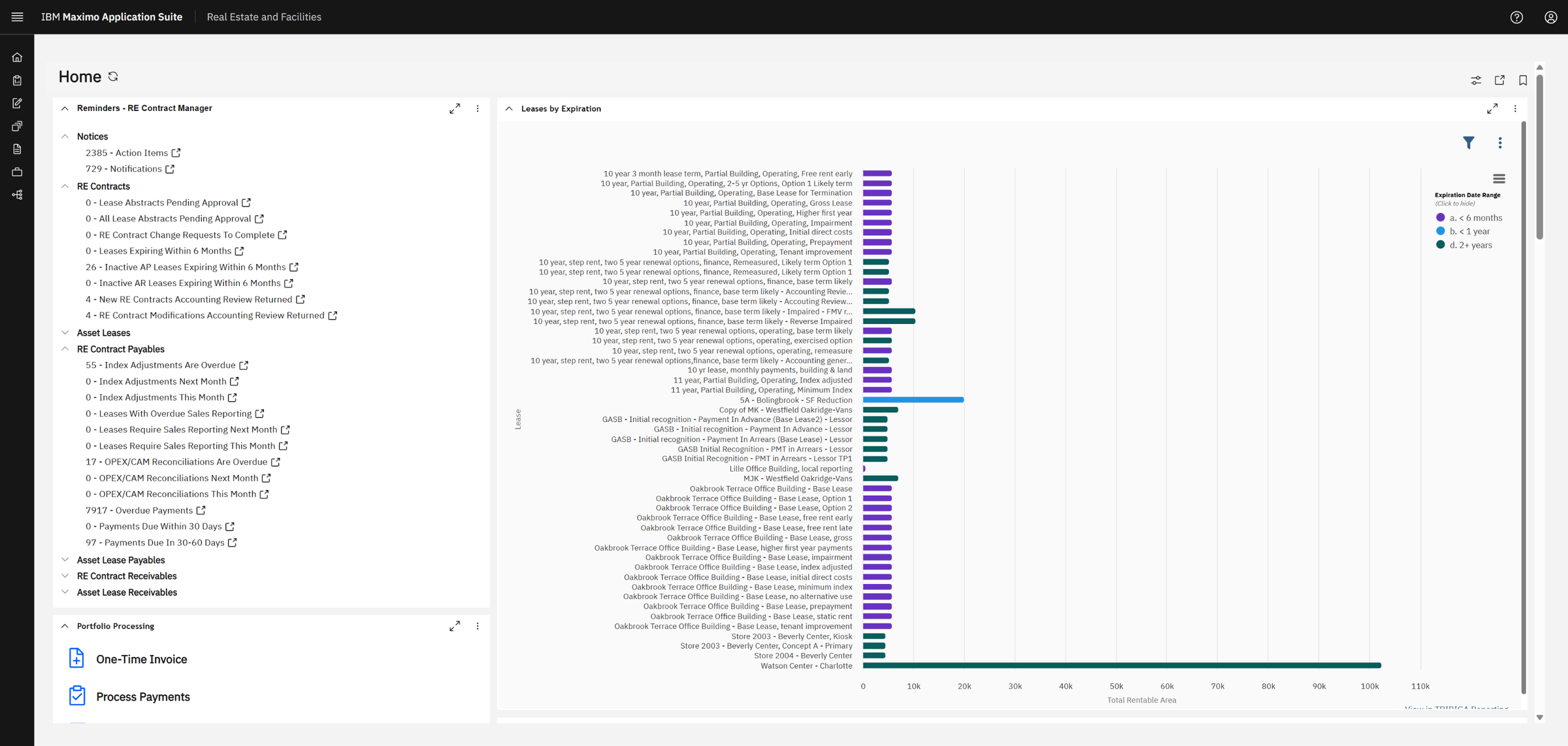
The reminders are the daily work: rent index adjustments that are due, OPEX/CAM reconciliations that are overdue, payments due in the next weeks, leases expiring within six months, and new leases sent back by the accountants for review. Nothing depends on someone remembering to look.
An AP lease (accounts payable) is one where you are the tenant: you pay rent. An AR lease (accounts receivable) is one where you are the landlord: you collect rent. Many organizations have both, often in the same building.
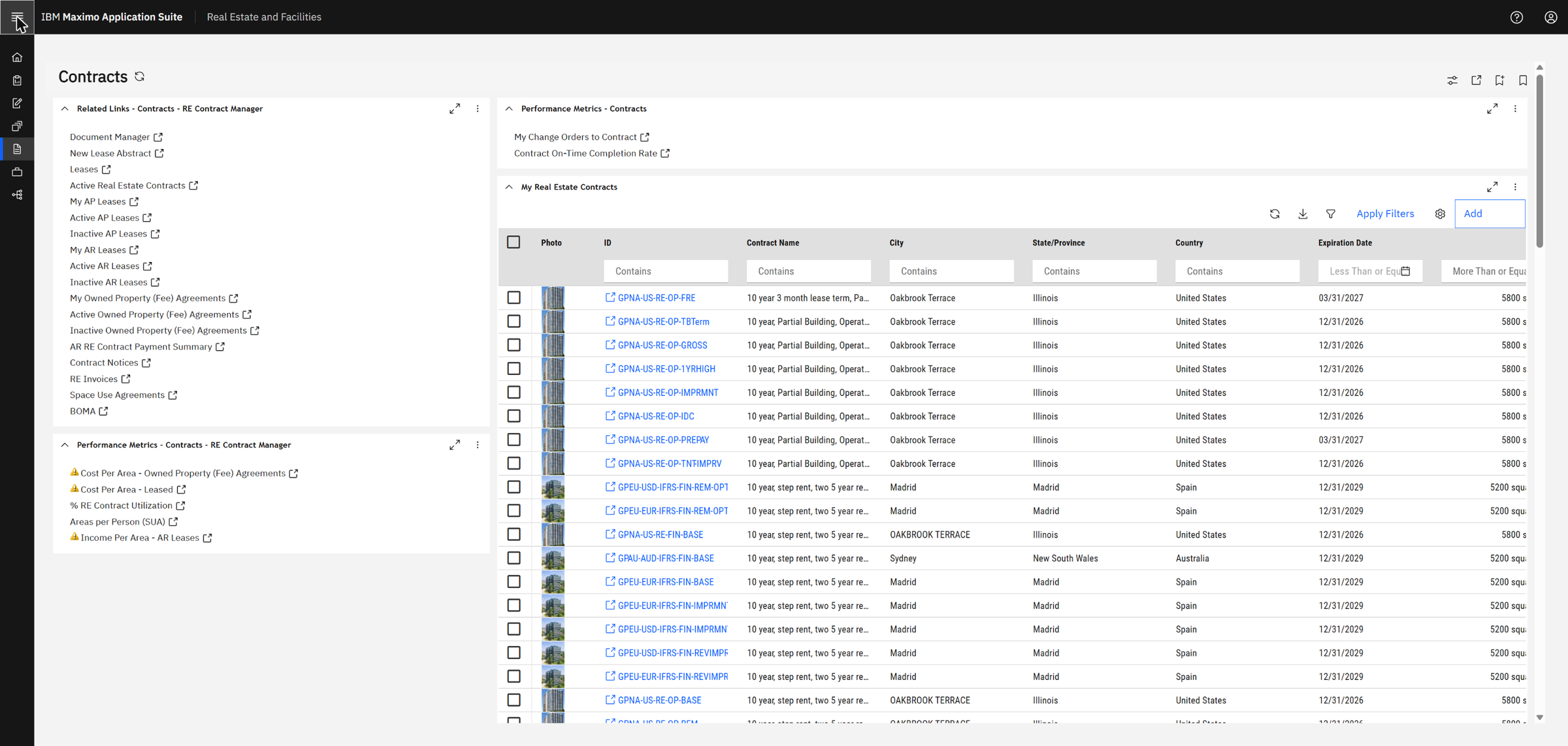
Chapter 2One building, five contracts
Search for the Watson Center and five contracts appear: the main lease that GreenPoint pays, and the leases to the companies that rent part of the building from GreenPoint.
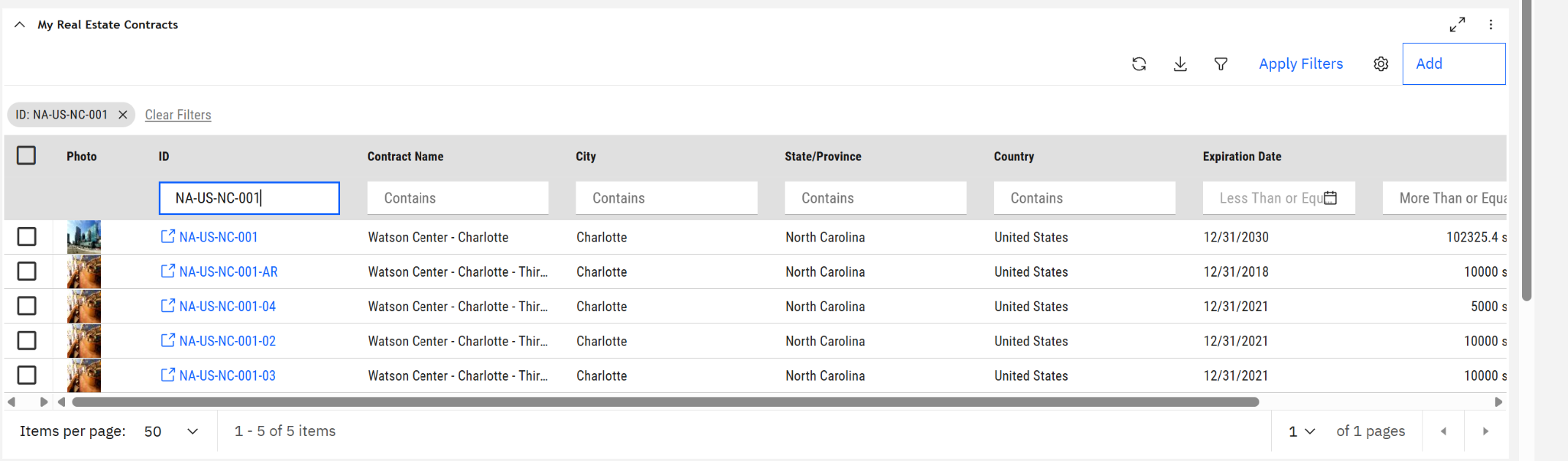
That is the first benefit of a system of record: one search shows every obligation and every source of income tied to a building, with its area and its expiry date.
Chapter 3Reading the lease
Turning a 60-page contract into data is called lease abstraction. The General tab holds the result: who, what kind of lease, how it is paid, and how it is accounted for.
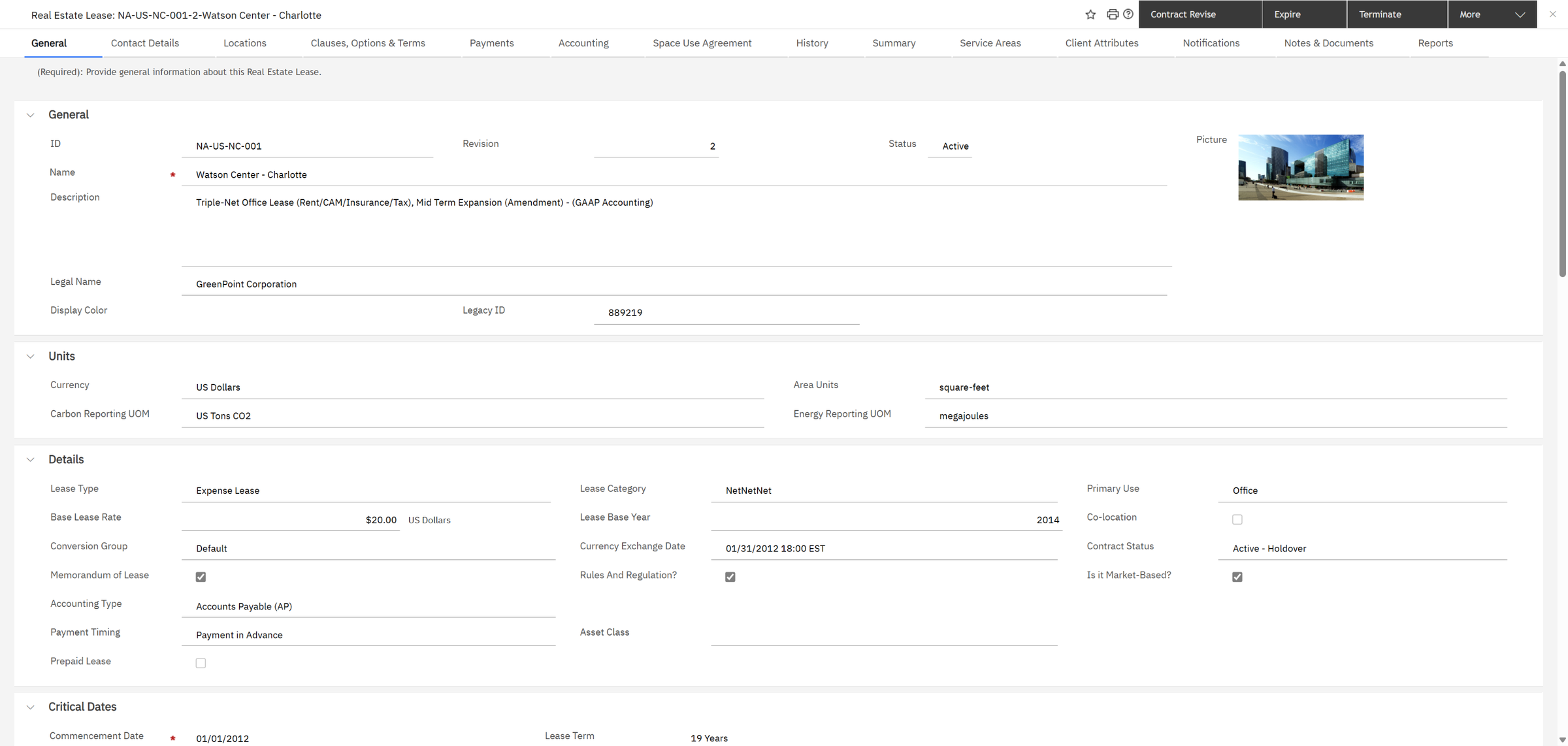
In a gross lease the rent covers everything. In a triple-net lease the tenant pays the base rent plus its share of the three "nets": the building's operating and common-area costs (CAM), its insurance and its property taxes. This lease is triple-net, so the payments in Chapter 6 have four lines, not one.
Further down are the dates that matter most. This lease started on 1 January 2012 for an original term to the end of 2017; renewals have taken it to 31 December 2030, nineteen years in total.
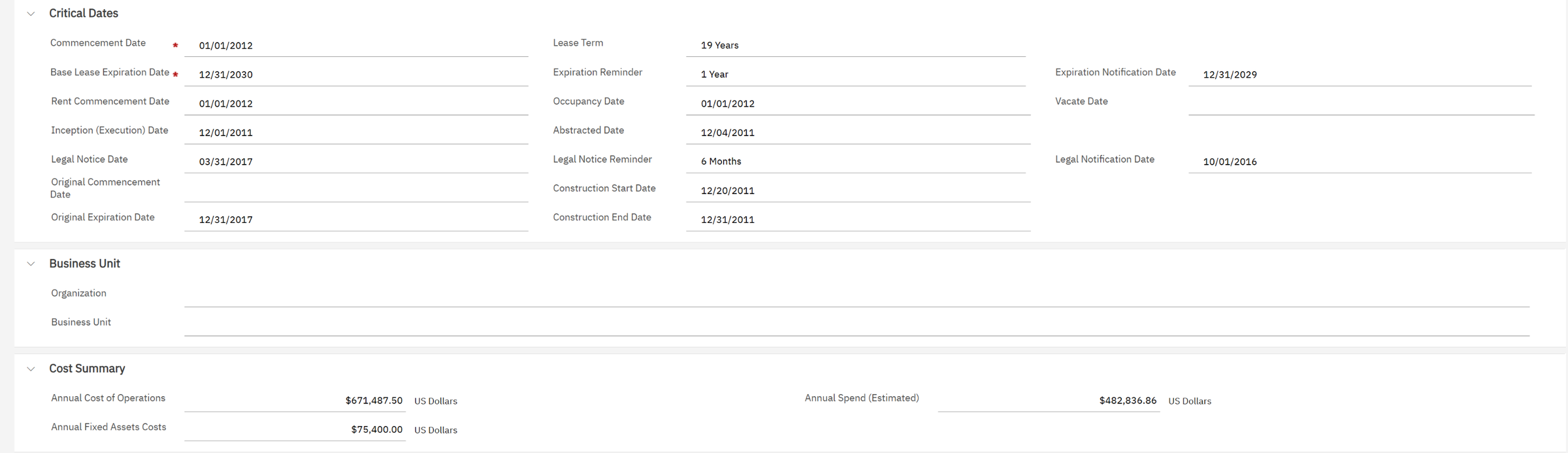
Expiration date 31/12/2030, expiration reminder 1 year → MREF raises the alert on 31/12/2029.
Legal notice date 31/03/2017, reminder 6 months → alert on 01/10/2016.
The reminder is set once, when the lease is abstracted, and the system does the remembering for the next 19 years.
Chapter 4Exactly which space, and which share
A lease covers specific space. The Locations tab ties it to the building's floors in the space plan, with both measurements that leases use.
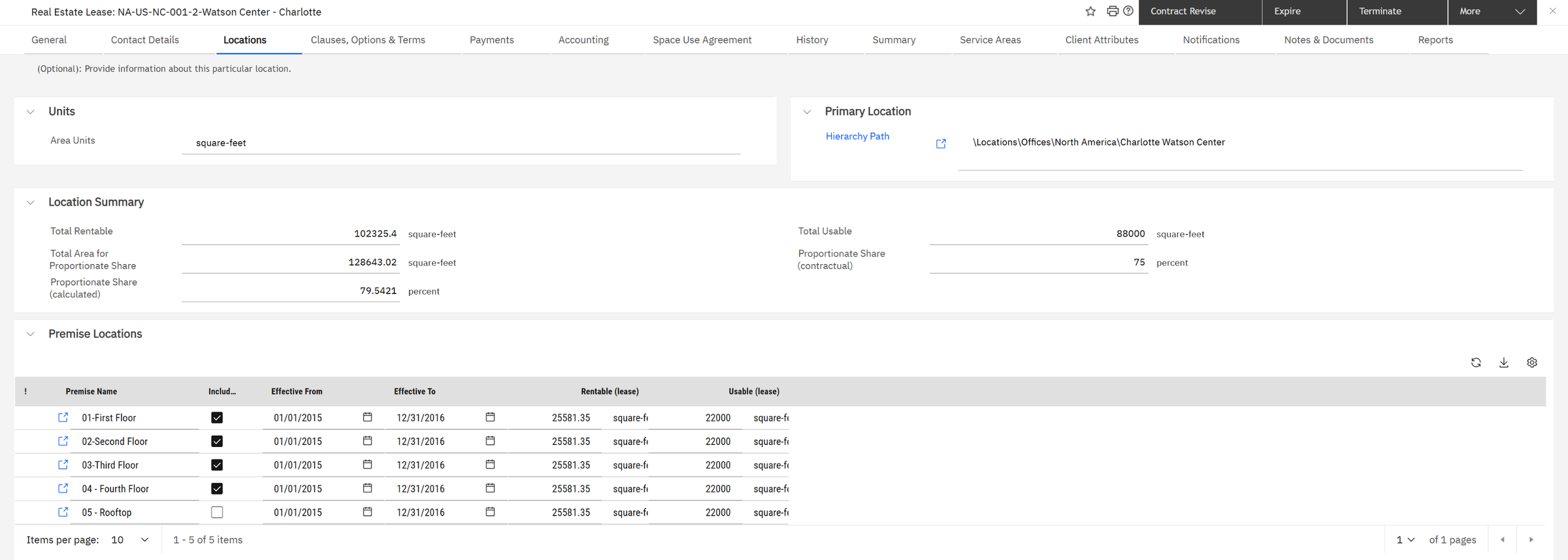
Usable area is the space you actually occupy. Rentable area adds your part of the common areas: lobbies, corridors, plant rooms. You pay rent on rentable area. Your proportionate share is your rentable area divided by the building's total, and it decides what part of the building's operating costs (CAM) you are billed.
Load factor = rentable ÷ usable = 102,325 ÷ 88,000 = 1.163: 16.3% of what GreenPoint pays for is common area.
Proportionate share (calculated) = 102,325 ÷ 128,643 = 79.54%. But the lease says 75% (contractual).
On a CAM bill of $1,000,000 that is the difference between $795,400 and $750,000: $45,400 a year that an unchecked landlord invoice could cost you. The contract wins, and the system knows both figures.
Chapter 5The fine print: clauses and options
Clauses are where risk and money hide. MREF stores each one by category with its section and page in the original document, so anyone can find "what does the lease say about insurance?" in seconds.
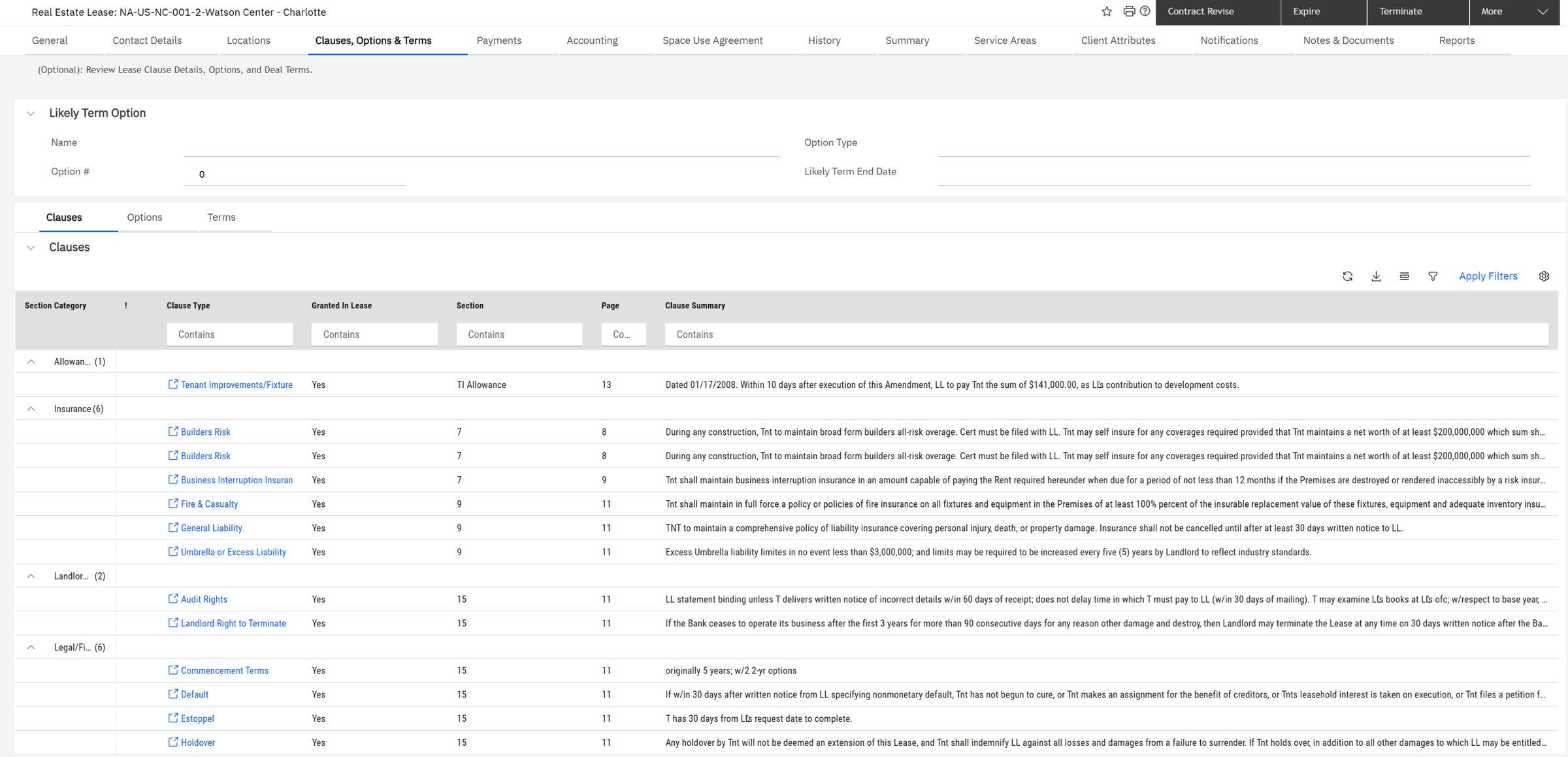
A few worth noticing: a tenant improvement allowance of $141,000 that the landlord must pay; insurance requirements including umbrella liability of at least $3 million; audit rights to check the landlord's operating-cost statements; and a holdover clause that makes staying past the end date expensive.

An option is a right, not an obligation: to renew, to expand, or to leave early (a break option). Every option has an exercise notice date: tell the landlord in writing by then, or lose the right. A missed notice date can force a company to leave a building it needs, or to stay in one it wanted to leave.
Four 2-year renewals carried the lease from 2018 to 2025. Renewal 5, for 5 years from 2026 to 2030, has status Exercised: its notice was due on 30/06/2024, eighteen months before it started. That is why the lease now ends in 2030.
Chapter 6The money: rent, CAM, insurance and tax
The Payments tab turns the lease into a payment schedule: one line per type of charge, with its rate, frequency and amount.
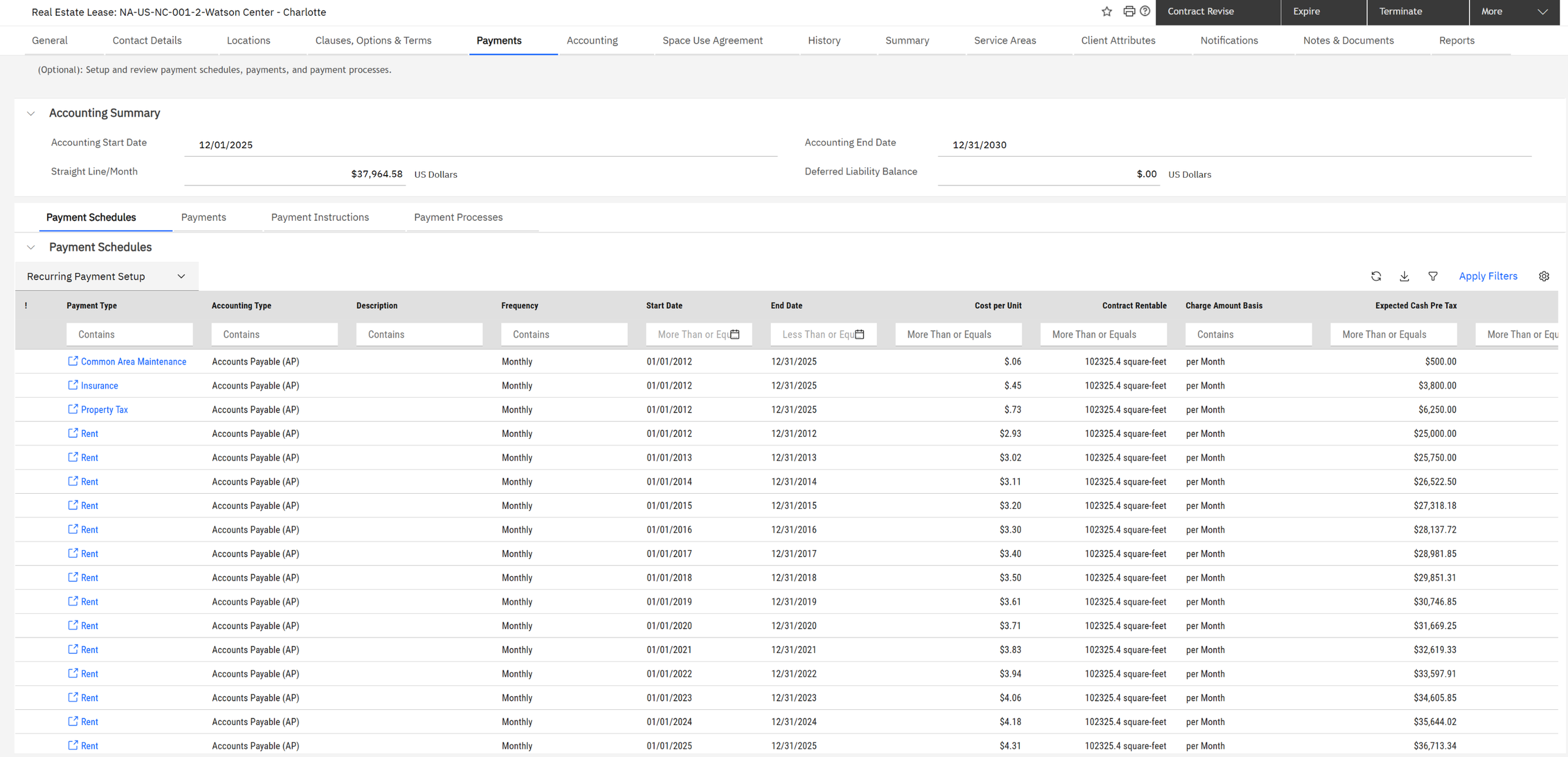
Rent in 2012: $25,000 a month. In 2013: $25,750. In 2014: $26,522.50. Each year is 3% more than the last: 25,000 × 1.03 = 25,750; 25,750 × 1.03 = 26,522.50.
The rate column is in dollars per square foot per year: $2.93 × 102,325 sq ft ÷ 12 ≈ $25,000 a month. By 2025 the rate is $4.31 and the rent $36,713.34 a month.
Because every step is in the schedule, there is no annual surprise and no missed increase. The same applies to rents linked to an inflation index: MREF schedules the index adjustments (the reminder you saw on the home page) and applies them when the index is published.
Chapter 7The accounting: why the expense is not the cash
Since ASC 842 (US GAAP) and IFRS 16, almost every lease must appear on the balance sheet, and its cost must be recognized in a specific way. The Accounting tab holds the choices: the standard, the dates, and the classification.
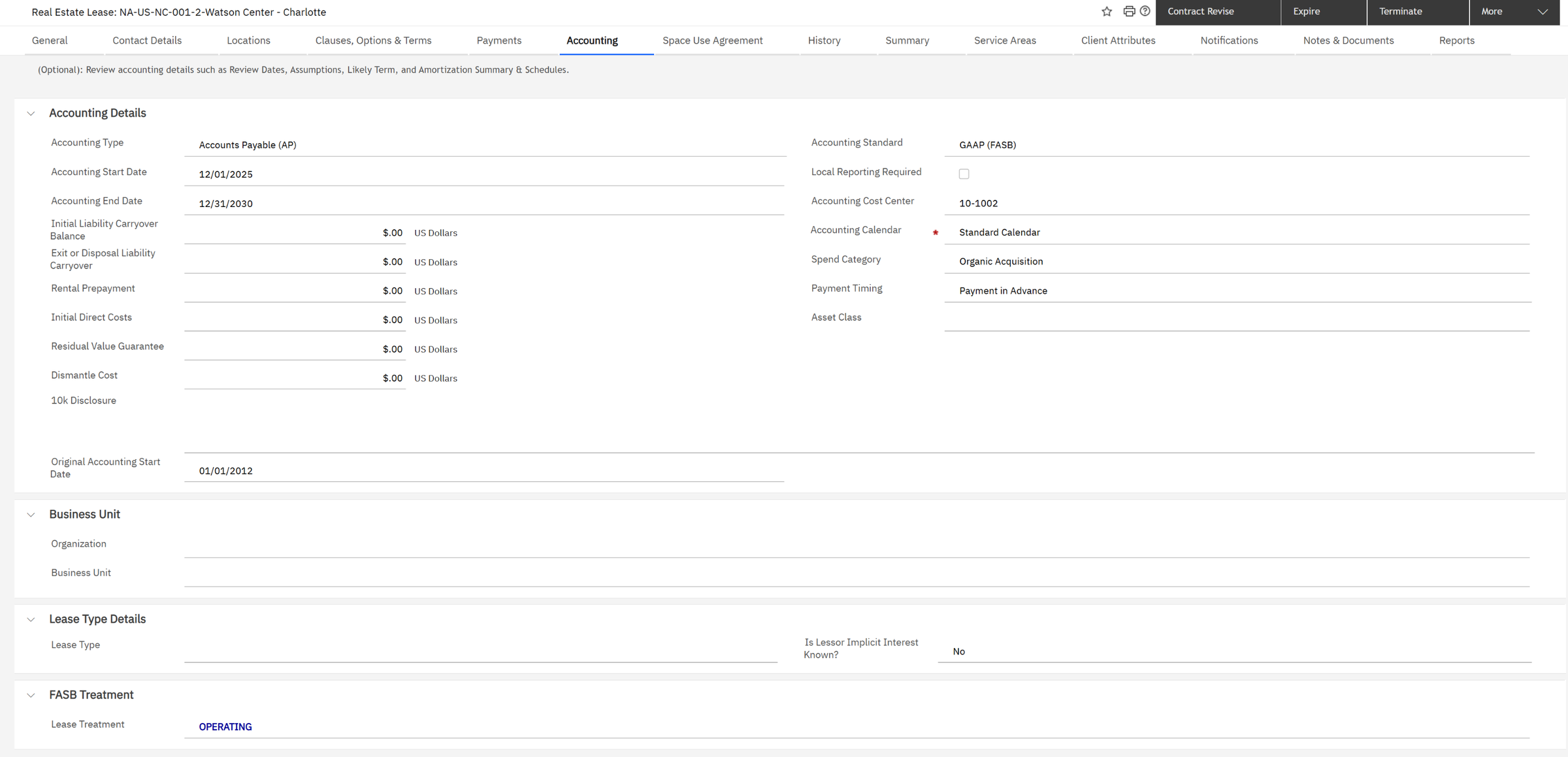
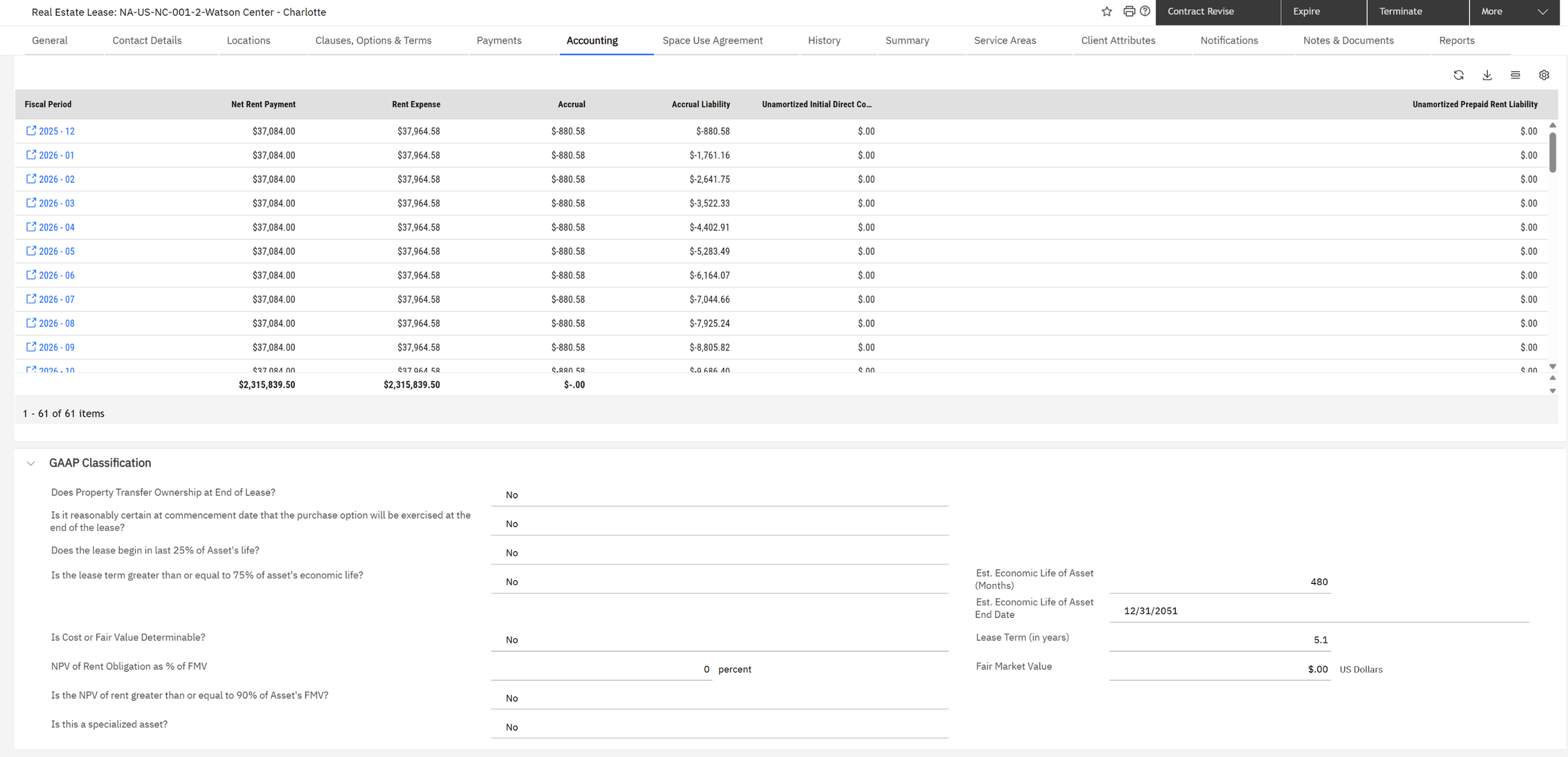
For an operating lease, the accounting expense is spread evenly over the term, even when the cash payments go up every year. The difference between the even expense and the actual cash builds up as a liability, which unwinds by the end of the lease.
Cash rent: $37,084.00 a month. Straight-line expense: $37,964.58. Difference: $880.58 a month, booked as an accrual. After ten months the accrued liability is 10 × 880.58 = $8,805.82, exactly what the screen shows for 2026-09.
Over the 61 remaining periods, both columns total $2,315,839.50: the same money, recognized on a different timetable.
The tests below the schedule decide the classification: does ownership transfer, is a purchase option certain, does the term cover most of the asset's life (75% here), are the payments worth most of its value (90% here), is the asset specialized? All answers are "No", so this is an operating lease. One "Yes" would make it a finance lease, with very different numbers.
Chapter 8Where we stand today
The Summary tab answers the questions management actually asks: how much do we still owe, how much have we paid, and is anything late?
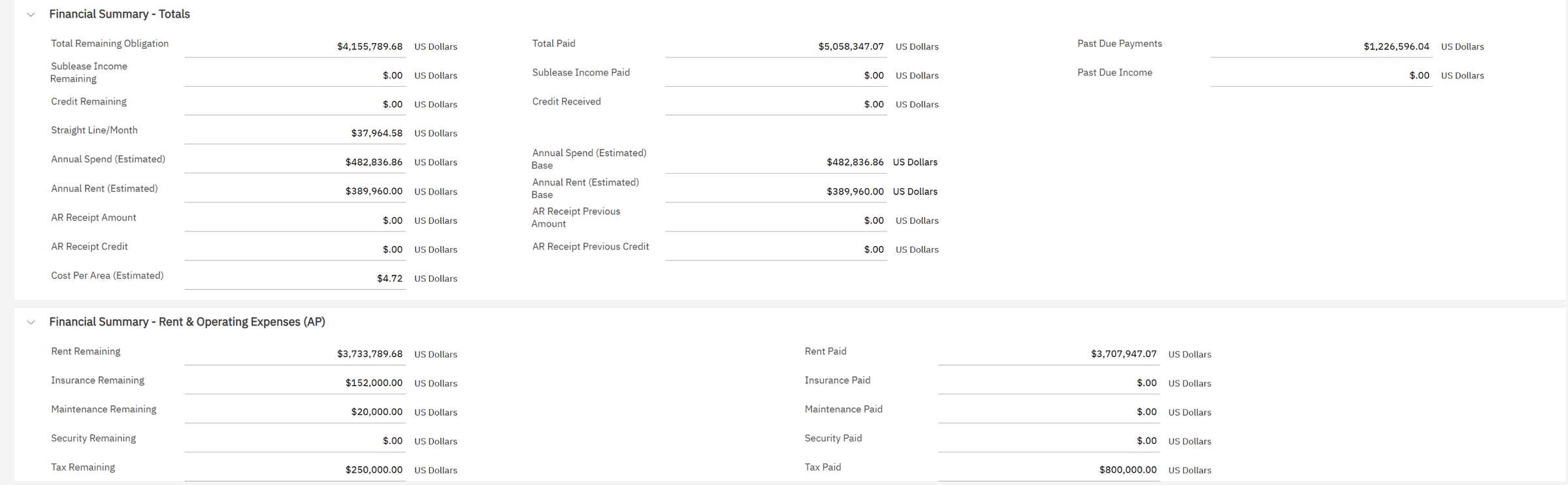
Remaining rent $3,733,789.68 + insurance $152,000 + maintenance $20,000 + tax $250,000 = $4,155,789.68 total remaining obligation, which matches the screen. The past-due figure ($1,226,596.04) is the line a lease administrator acts on first.
Chapter 9The other side: GreenPoint as landlord
Part of the Watson Center is let to other companies. Those contracts live in the same place, with the same structure, but they are income leases: GreenPoint bills them.
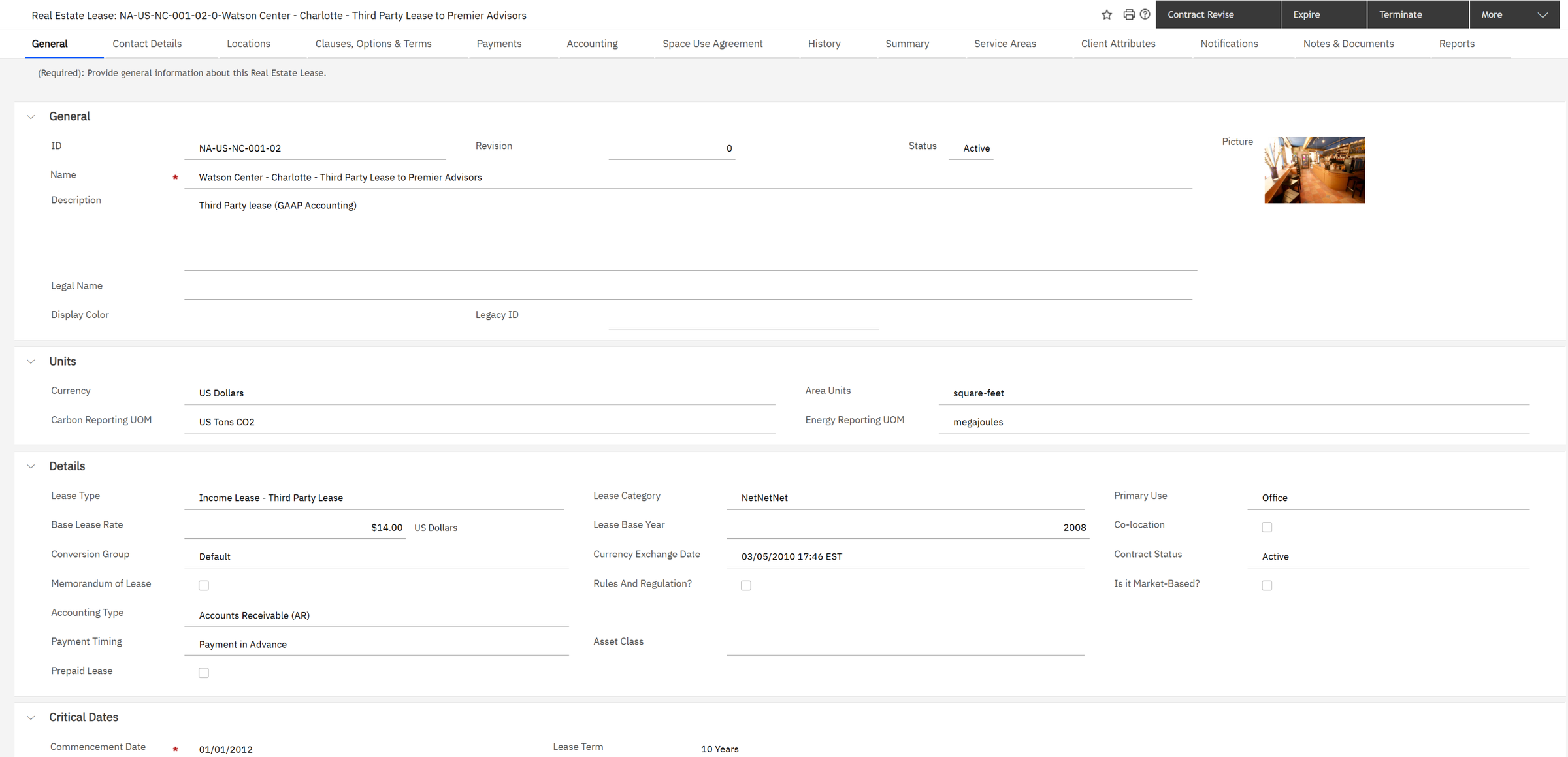
Two things stand out. The accounting type is Accounts Receivable: MREF generates the lease invoices, records the receipts, and flags past-due income. And the base rate is $14, against $20 on the head lease GreenPoint pays: subletting recovers part of the cost of space GreenPoint does not use, and the system shows exactly how much.
lleases. Contracts opens the workspace; Contracts › Leases
the lease list; Contracts › Receivables › Generate Lease Invoices the billing runs; Contracts › Payables › Real Estate
Transactions the index adjustments and OPEX/CAM reconciliations.What this gives the organization
- No missed dates. Renewals, breaks and notices raise their own alerts, years ahead.
- No unchecked bills. Rent steps, index adjustments and CAM shares come from the contract, not from the landlord's invoice.
- Audit-ready accounting. ASC 842 / IFRS 16 classification and straight-line schedules computed from the lease itself.
- Both sides in one place. Leases you pay and leases you bill, tied to the same buildings and floors.
- Answers on demand. What we owe, what is late, what expires next: on one screen, for one lease or the whole portfolio.
Check yourself
1. A tenant occupies 20,000 sq ft usable and pays for 23,000 sq ft rentable. What is the load factor?
23,000 ÷ 20,000 = 1.15: 15% of the area paid for is common area.
2. Rent is $10,000 a month and rises 3% a year. What is it in year 3?
10,000 × 1.03 × 1.03 = $10,609 a month.
3. A renewal option's exercise notice date passes without notice. What happens?
The right to renew is usually lost. The tenant must negotiate a new deal, from a weaker position, or move out.
4. Why is the straight-line expense higher than the cash rent at the start of a lease with rising rent?
Because it spreads the total of all payments, including the higher future ones, evenly over the term. The gap is booked as a liability that unwinds later.
5. The calculated share is 79.54% but the lease says 75%. Which one does the landlord bill?
The contractual 75%. Checking the landlord's bill against the contract is exactly what an OPEX/CAM reconciliation does.
Glossary
- Lease abstract
- The key terms of a lease captured as structured data.
- AP / AR lease
- A lease you pay (accounts payable) / a lease you bill (accounts receivable).
- Triple-net (NNN)
- Lease where the tenant pays base rent plus its share of operating costs, insurance and taxes.
- CAM
- Common Area Maintenance: the building's shared operating costs, recharged to tenants.
- Rentable / usable area
- Area paid for, including common areas / area actually occupied.
- Proportionate share
- The tenant's part of the building, used to split operating costs.
- Option
- A right to renew, expand or leave early, with a deadline to exercise it.
- Holdover
- Staying after the lease ends, usually at a penalty rent.
- Index adjustment
- A rent change linked to an inflation index.
- OPEX/CAM reconciliation
- Checking the landlord's actual operating costs against what was paid during the year.
- ASC 842 / IFRS 16
- The accounting standards that put leases on the balance sheet.
- Straight-line rent
- Spreading the total rent evenly over the lease term for accounting.
- Operating / finance lease
- The two classifications under US GAAP, decided by the classification tests.
Want to see this with your own leases? Send me a message and I'll set up a demo.
Screens: IBM Maximo Real Estate and Facilities on IBM Maximo Application Suite, with IBM's GreenPoint demo data. All names, amounts and dates are demo values.